


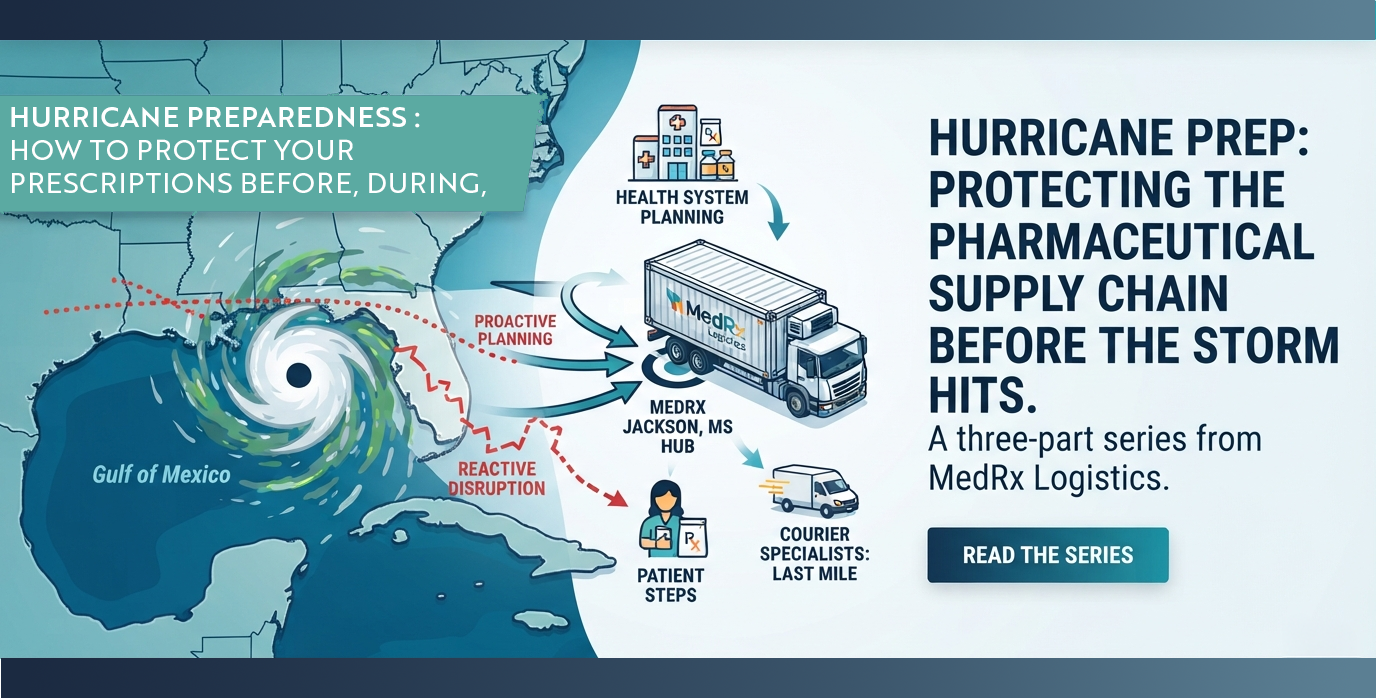
In this second article of the series, we’re going to discuss what patients and consumers should do to protect themselves and their prescriptions during hurricane season. If you take prescription medications, a hurricane is not just a weather event. It is a medication supply event. Power outages, road closures, flooded pharmacies, and forced evacuations can all put your therapy at risk at exactly the moment when stress on your body is highest. The good news: most medication-related hurricane crises are preventable. This guide walks you through exactly what to do.
Before the Storm: What to Do When a Watch Is Issued
Call Your Pharmacy As Soon As a Storm Watch Is Issued
Do not wait until the day before the storm. The moment a hurricane watch is issued for your area, call your pharmacy. Most insurance plans have early refill exceptions during a declared state of emergency. Many will authorize a 30-day emergency supply of maintenance medications, including blood pressure medications, diabetes medications, thyroid medications, and psychiatric medications, even if you are not yet due for a refill.
Your pharmacist is your best resource. They know your medication history, your insurance plan, and they deal with these situations every hurricane season. Do not try to navigate it alone.
Make a Written Medication List Before You Leave
Before you do anything else, write down every medication you take. For each one, note:
- The full medication name (brand and generic if you know it)
- The dose and how often you take it
- The name of the doctor who prescribed it
- The pharmacy where you normally fill it
Keep one copy in your wallet and one in your phone’s notes app. Take a photo of your pill bottles if that is easier. If your medications are lost or destroyed in a flood, this list is what gets you back on therapy quickly at an out-of-town pharmacy.
Pack Your Medications in Your Emergency Kit
When you are packing to evacuate, your medications are a top-three priority alongside your identification and your phone charger. A zip-lock bag inside a hard-sided waterproof container is a reliable setup for oral medications. They go in whatever you are carrying when you walk out the door, not in a box packed into a trailer.
Know Whether Your Medication Needs to Stay Cold
Insulin, certain eye drops, some liquid antibiotics, and many injectable biologics require refrigeration. Before the storm, ask your pharmacist two questions:
- How long can this medication safely be stored at room temperature if I lose power?
- What should I do if it has been exposed to heat for longer than that?
Many insulins can be kept at room temperature for 28 to 30 days without significant potency loss, but that limit varies by product. Ask your pharmacist now, while you have time to get a clear answer. If you need to transport a refrigerated medication during an evacuation, a small insulated cooler with ice packs is your best option.
If You Are Evacuating: How to Reroute Your Prescriptions
This is the question most patients do not think about until they are already 200 miles from home. Here is the step-by-step process.
| Step | What to Do |
|---|---|
| 1 | Call your pharmacy before you leave town. Tell them you are evacuating and give them the address where you will be staying. If you have a specialty pharmacy that ships your medications directly, ask them to hold your next scheduled shipment and reroute it to your evacuation address. Get a confirmation number. |
| 2 | Request a prescription transfer if your pharmacy may be closed. Ask your pharmacy to transfer your prescription to a pharmacy near where you are evacuating before the storm hits. Most major chains, including CVS, Walgreens, and Walmart, can fill a transferred prescription at any of their locations nationwide. |
| 3 | Know your state’s emergency dispensing rules. During a declared emergency, most Gulf and Southeast states activate emergency pharmacy laws. In Louisiana, a pharmacist can dispense a 30-day emergency supply based solely on your verbal description of your prescription history. Tell the pharmacist you are evacuating from a hurricane disaster area and ask what they can do under the current declaration. |
| 4 | Contact your prescriber remotely if you need a new prescription. Most physicians can send an electronic prescription to any pharmacy in the country from their system. A telehealth visit can be completed from your phone from anywhere with a signal. |
| 5 | If you take a specialty medication, call the specialty pharmacy directly. Explain that you are evacuating, provide your temporary address, and ask whether your next shipment can be expedited. Specialty pharmacies deal with this every hurricane season. Call them before you leave, not after. |
During the Storm: What Not to Do
Do not drive to a pharmacy during a storm. No prescription is worth driving through storm conditions or flooding. If you prepared in advance, you have your medications with you.
Do not assume a pharmacy is open. Many pharmacies close or limit hours during and immediately after a storm. Call before you go.
Do not take a medication that has been submerged in floodwater. If your medications were reached by flooding, consider them compromised. See the next section for what to do.
After the Storm: Getting Back on Track
Check Your Medications Before Taking Them
- Oral medications submerged in floodwater should be discarded
- Sealed bottles not submerged may be okay, but call your pharmacist before taking them
- Refrigerated medications without power longer than your pharmacist advised should be discarded or confirmed safe
- Injectable medications and biologics should be inspected for changes in color, clarity, or particulates before use
When in doubt, call your pharmacist before taking anything you are unsure about. Getting a replacement supply is a solvable problem. Taking a compromised medication is a health risk.
Contact Your Pharmacy When You Return
As soon as you are back home, call your pharmacy and update your delivery address if it changed. If your medications were lost or damaged in the storm, your pharmacist can help you work with your insurance company to authorize a replacement supply. Call them as soon as possible: this process is generally more straightforward during a declared emergency, but it needs to be initiated by your pharmacist.
Talk to Your Doctor If You Missed Doses
If you missed doses of your medication during the storm, do not assume you know how to get back on track. For some medications, a few missed doses are clinically insignificant. For others, stopping and restarting requires a specific protocol. Call your prescriber or your pharmacist, tell them which medication you take and how many doses you missed, and let them guide you back onto therapy safely.
Quick Reference: Your Pre-Storm Medication Checklist
Before a storm watch is issued, have ready:
- A written medication list with drug names, doses, and prescribing doctors
- At least a 14-day supply of all maintenance medications on hand
- Your pharmacy’s phone number saved in your phone, including after-hours contact if available
- Your specialty pharmacy’s patient services number, if applicable
- Knowledge of whether your medications require refrigeration and the safe room-temperature limit
- A waterproof bag or container designated for medications in your emergency kit
When a watch is issued:
- Call your pharmacy and request an emergency early refill
- If evacuating: call to hold or reroute shipments and transfer prescriptions
- If on a specialty medication: call the specialty pharmacy to coordinate shipment rerouting
- Take a photo of all your pill bottles before you pack them
Contact MedRX Logistics at medrxlogistics.com for more resources. If you are a patient with questions about a MedRX delivery during an active storm event, contact your pharmacy or specialty pharmacy directly.