


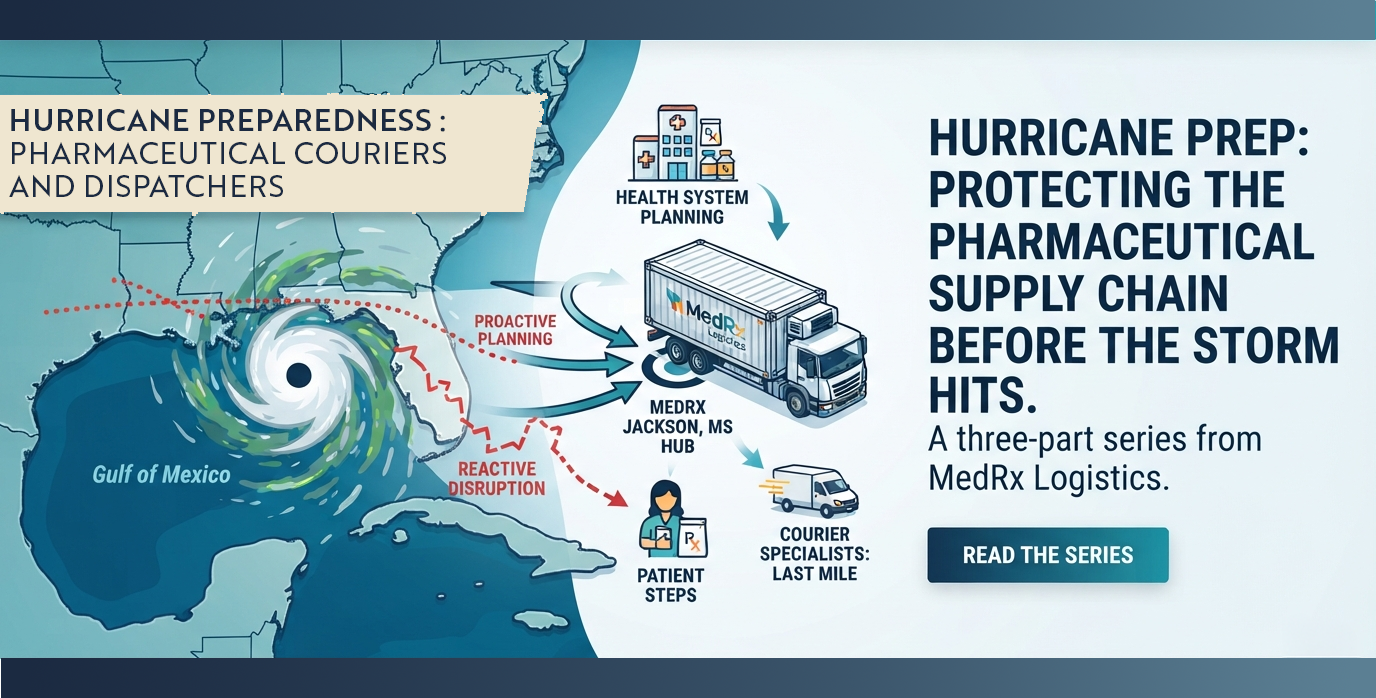
Hurricane Season Preparedness for Courier Specialists: The Operational Playbook for Pharmaceutical Delivery in Storm Conditions
Most hurricane preparedness content is written for pharmacies or patients. This one is written for you: the courier specialist, dispatcher, route manager, or logistics coordinator who is actually on the road or running the board when a storm hits.
Pharmaceutical delivery during hurricane season is a different job than pharmaceutical delivery in normal conditions. The medications on your truck are not retail goods. They are therapies patients depend on to stay alive, manage chronic illness, or complete a clinical trial. When the supply chain breaks down during a storm, you are often the last person standing between a patient and a medication gap.
Before the Season Starts: Know Your Routes, Know Your Risks
Map Your High-Risk Corridors
Before June 1, identify which parts of your delivery territory are most vulnerable to storm disruption. High-risk delivery zones generally include:
- Coastal and low-lying areas prone to storm surge: coastal Louisiana parishes, the Mississippi Gulf Coast, Mobile Bay communities, and coastal Florida markets
- Areas with single-road access that become impassable before a storm even makes landfall: barrier islands, causeway-connected communities, and low-elevation corridors
- Markets where the local pharmacy or medical facility you deliver to has a history of closing or evacuating during storm events
Know these routes before the season starts. Know the alternate routes. Know where the nearest inland hub is if a delivery address becomes unreachable.
Understand Your Cold Chain Responsibilities
A temperature excursion is a temperature excursion whether it happens on a clear Tuesday in March or during a Category 2 hurricane. Before the season, confirm you have clear written answers to:
- What is the acceptable temperature range for the products on your route, and what monitoring equipment are you using to verify it?
- What is the protocol if your vehicle’s temperature control system fails mid-route?
- What do you do if a delivery address is inaccessible and you cannot complete a delivery as scheduled?
- Who is your immediate point of contact for a chain-of-custody issue or a product integrity question in the field?
If you do not have clear written answers, raise them with your dispatcher or operations manager now. These decisions need to be made at the organizational level before a storm, not by an individual driver in the field during one.
Know Your Documentation Requirements
Pharmaceutical delivery documentation requirements do not get relaxed during a storm. DSCSA chain-of-custody records need to be complete. Temperature logs need to be captured. Proof of delivery needs to be recorded. Know what to do when you cannot complete a normal delivery: address inaccessible, recipient unavailable, storm forces a return. Know who to call and what records to create in each scenario.
When a Storm Is Approaching: Pre-Storm Operations
Follow the Dispatch Hold Protocol, Not Your Own Judgment
When a storm is actively threatening your delivery corridor, the decision about whether to attempt deliveries is not yours to make as a driver. That decision belongs to your dispatcher and operations leadership, who have a fuller picture of storm track forecasts, road conditions, and organizational risk.
Communicate proactively with dispatch about:
- Which deliveries on your schedule are in high-risk zones
- Which recipients you have already contacted about storm timing
- What the condition of specific routes looks like if you have firsthand knowledge
Do not attempt a delivery into a storm-threatened zone without explicit authorization from your dispatcher. The liability for a vehicle accident, a product loss, or a cold chain failure in an unauthorized delivery run falls heavily on the driver.
Contact Recipients for Time-Sensitive Deliveries
For specialty pharmacy deliveries and other time-sensitive shipments scheduled in the 24 to 48 hours before projected landfall, direct contact with the recipient is part of your pre-storm protocol. A cold chain product delivered to a home where the patient has already evacuated is a product integrity failure. A patient who needs to reroute their shipment needs that information relayed to your dispatcher immediately.
When in doubt about a delivery, call the recipient. When in doubt about whether to make a delivery, call your dispatcher.
Vehicle and Equipment Readiness
Before a storm approaches, verify:
- Temperature monitoring equipment is calibrated and logging correctly
- Backup cooling capacity (ice packs, portable refrigeration units) is stocked and functional
- Fuel tank is full, not just adequate. Post-storm fuel availability in Gulf Coast markets is unpredictable
- Physical map or offline navigation is available as a backup to GPS, which can be unreliable during a storm
- Personal emergency vehicle kit is stocked: water, food, flashlight, first aid kit, phone charger
During and Immediately After a Storm: Field Operations
Do Not Drive Into Conditions You Cannot Assess
The most important safety rule is the simplest: do not drive into conditions you cannot see or assess. Flooded roads kill drivers. A road that looks passable from a distance may have fast-moving water that will disable your vehicle.
Turn around, don’t drown. No delivery is worth a vehicle in floodwater.
What to Do When a Delivery Address Is Inaccessible
- Do not attempt to navigate an impassable route
- Contact dispatch immediately and report the specific address and the nature of the obstruction
- For temperature-sensitive product, note the current product temperature in your log and report it to dispatch
- Return the product to your hub or an alternate holding location per your organization’s protocol
- Document the failed delivery attempt with time, location, and reason
Never leave a pharmaceutical product unattended at an inaccessible delivery address. If you cannot hand it to an authorized recipient, it returns with you.
Chain-of-Custody in a Storm Scenario
When a storm forces a non-standard delivery outcome, the chain-of-custody documentation for that product needs to be complete and accurate. For each non-standard event, document:
- The product, lot number, and quantity involved
- The time and temperature at the time of the event
- The reason for the non-standard outcome
- The current location and custody of the product
- The name of the dispatch or operations contact who authorized the action
Temperature Excursion Protocol
If a temperature excursion occurs during a storm delivery, treat it the same way you would on any other day: document it immediately, report it to dispatch, quarantine the affected product, and do not complete delivery of a product you have reason to believe may be compromised. A temperature excursion during a storm does not suspend your compliance obligations. It increases the importance of getting the documentation right.
Post-Storm Operations: Resuming Deliveries Safely
Wait for Route Clearance Before Resuming
After a storm passes, do not resume deliveries without confirmation from your dispatcher that your routes have been assessed and cleared. Roads that look passable may have structural damage, debris, or contaminated floodwater that is not visible from a vehicle.
Prioritize Time-Sensitive Backlog First
When deliveries resume after a storm, there is typically a significant backlog of held shipments. Work with your dispatcher to understand which products in that backlog are most time-sensitive:
- Specialty medications for patients on active therapy
- Temperature-sensitive products with limited hold windows
- Medications for facilities serving patients who could not evacuate
Document Storm-Delayed Deliveries
Every delivery that was delayed or rerouted due to storm conditions needs to be documented as such. This is relevant for the receiving pharmacy’s compliance records, for insurance claims on any lost or compromised product, and for your organization’s post-storm operational review. When in doubt, over-document.
Your Pre-Storm Readiness Checklist
Before June 1:
- High-risk routes and alternate routes identified
- Cold chain protocols and documentation requirements confirmed in writing
- Vehicle temperature monitoring equipment verified and calibrated
- Emergency escalation contacts saved in phone and on paper
- Personal emergency vehicle kit stocked
When a storm watch is issued:
- Contact dispatch to review schedule for storm-affected deliveries
- Contact recipients for time-sensitive deliveries in high-risk zones
- Fuel vehicle fully
- Verify backup cooling supplies are stocked and functional
- Confirm offline navigation backup is available
When storm conditions are active:
- No deliveries without explicit dispatch authorization
- Report inaccessible routes immediately with specific location and nature of obstruction
- Document all non-standard delivery outcomes in real time
- Report any temperature events immediately
- Never leave product unattended at an inaccessible address
Resuming post-storm:
- Wait for route clearance confirmation before entering previously flooded areas
- Work with dispatch to prioritize time-sensitive backlog
- Document all storm-delayed or rerouted deliveries explicitly
MedRX Logistics: Built for Gulf South Conditions
MedRX Logistics operates pharmaceutical distribution across the Gulf South with a fleet and operations infrastructure designed around the realities of hurricane season. Our Jackson, Mississippi hub serves as an inland routing point when coastal corridors are threatened. Our real-time tracking and chain-of-custody documentation systems maintain compliance integrity even when storm conditions create non-standard delivery outcomes.
Interested in joining a pharmaceutical distribution team that takes storm operations seriously? Learn more at medrxlogistics.com.
 |
 |