


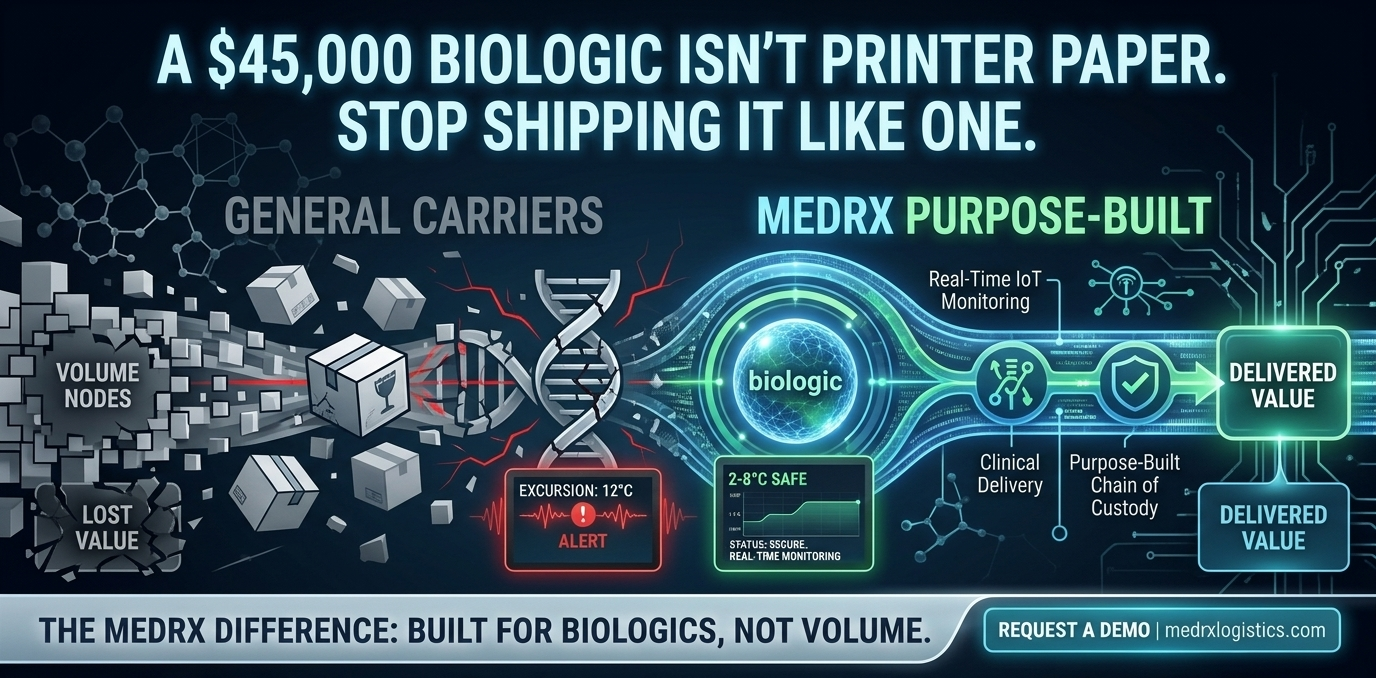
A $45,000 biologic doesn’t get extra handling because it’s worth $45,000. To a standard parcel carrier, it gets the same dock, the same truck, and the same tracking update as a box of printer paper. For specialty pharmacies and infusion centers, that isn’t a hypothetical risk: it’s how product is lost, patients are delayed, and accreditation audits get complicated.
The Core Problem: General Carriers Were Built for Volume, Not Compliance
Standard courier networks are optimized for throughput. They move millions of packages per day with impressive reliability for conventional cargo. But specialty biologics aren’t conventional cargo. They require:
- Continuous temperature maintenance within a 6-degree Celsius window
- DSCSA-compliant chain of custody documentation at every handoff
- Clinical delivery windows: not estimated arrival ranges
- Immediate response protocols when something goes wrong in transit
Standard carriers were not designed to provide any of these things. What they offer is adapted, bolted on, or simply absent: And the gap shows up in excursion reports and audit findings.
Three Specific Ways Standard Carriers Fail Biologic Shipments
1. Snapshot Logging Instead of Real-Time Monitoring
Most standard carriers use temperature data loggers — small devices that record temperature readings at intervals and produce a report at the end of a shipment. The problem is that the report comes after delivery. If a temperature excursion happened at hour four of a six-hour transit, you find out when the driver hands you the package.
By then, you have two bad options: use a product that may have been compromised, or discard it and start the replacement process. Neither is acceptable for a patient whose infusion is scheduled for this afternoon.
| Real-time IoT monitoring sends an alert within minutes of a temperature deviation. The difference between snapshot and real-time isn’t just technical , it’s the difference between reacting after the fact and preventing a loss. |
2. No Clinical Delivery Commitments
When a patient’s infusion is scheduled for 10 a.m., the biologic needs to arrive before that, not within a four-hour delivery window, and not “by end of day.” Standard carriers offer estimated windows, not coordinated clinical delivery commitments.
Infusion centers schedule chairs, clinical staff, and nursing time around drug arrival. When a carrier misses the window, it isn’t just a logistics inconvenience, it cancels patient care.
|
$15B
Lost annually in pharma from temperature excursions
|
1 in 5
Biologic shipments experience a temperature event
|
$50K
Average cost of a single cold chain excursion
|
3. No Prioritization of Delivery
Are you worried to ship on Fridays, because your packages keep sitting in a distribution center until Monday? You’re not the only one!
When the weekend rolls around, or the Holidays approach, standard carriers are going to treat your pharmaceuticals the same as every other package. Packages get delayed, sit in distribution centers, and spoil long before they reach the customer. MedRx doesn’t ship Christmas presents, and we don’t slow down on the weekends. Every package is handled like it’s worth $50,000, because to the customers waiting on their delivery, it is.
What “Purpose-Built” Actually Means
MedRX was not adapted from a general parcel carrier. It was built from the ground up for pharmaceutical last-mile logistics. Which means the operational model, documentation systems, driver training, and technology were all designed around what specialty biologics require, not retrofitted to accommodate them.
The distinction matters because retrofitted solutions carry the assumptions and limitations of the original platform. A logistics company that added cold chain capability as a product line is still running a general carrier with a cold chain attachment. MedRX runs cold chain logistics.
| If your current logistics provider can’t produce complete auditable records, provide pre-delivery temperature alerts, or commit to a specific clinical delivery window: You’re using the wrong carrier for what you’re shipping. |
|
Ready to protect every biologic you dispense?
|